
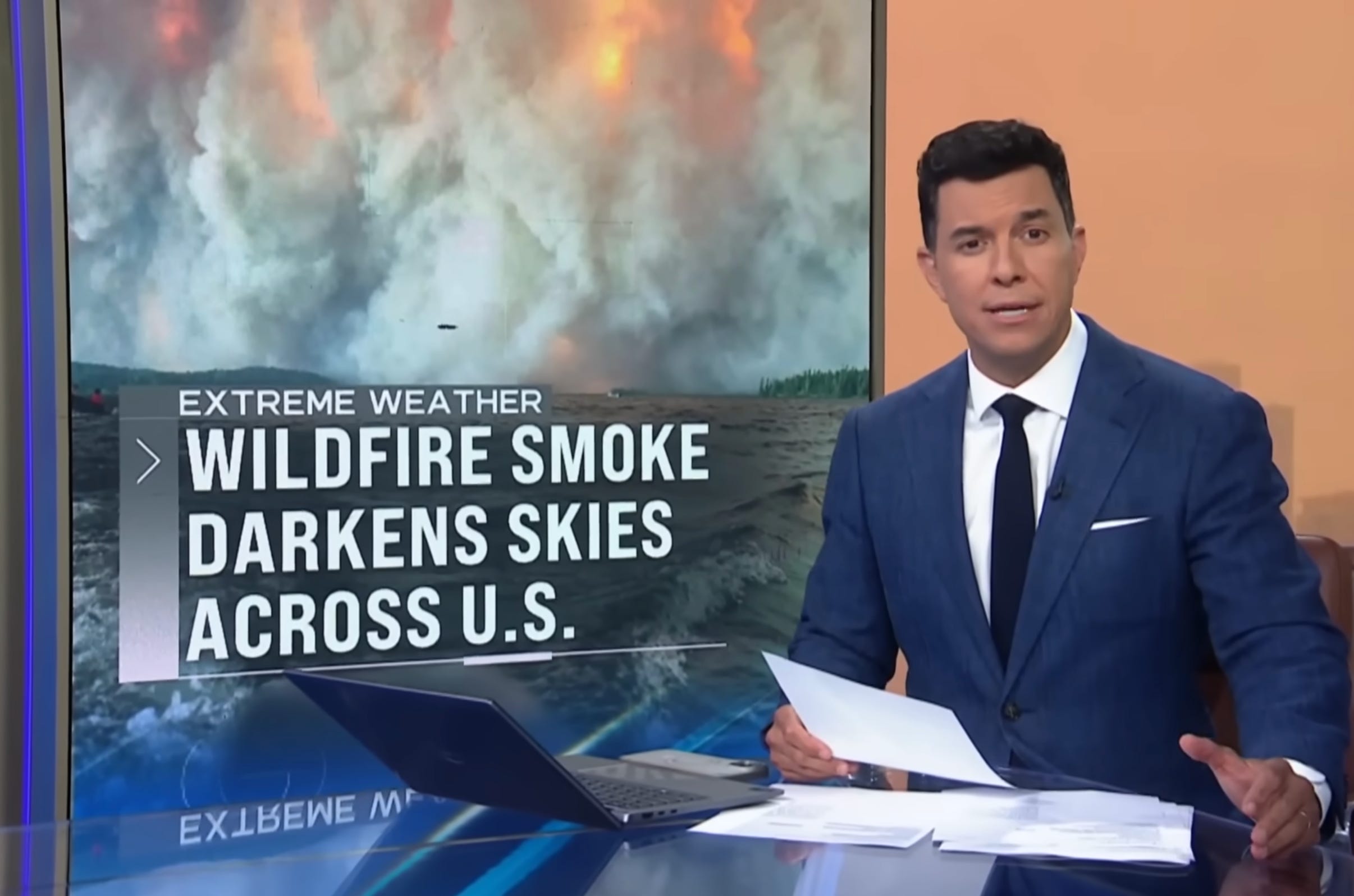
The nightly news programs this past week completely ignored climate change’s role in recent catastrophic weather events, including tornadoes, deadly floods across the Carolinas, southeastern Virginia and the Tennessee Valley, and toxic smoke from wildfires that blanketed much of the upper United States.
NBC News did not mention climate change once in extreme weather events its seven broadcasts, nor did ABC World News in its seven broadcasts. In their six broadcasts, CBS Evening News also ignored climate change entirely, though reporter Taurean Small did have one vague mention of a “warming climate” in his July 18 report on the wildfires, but made no mention of “climate change” or human-caused “global warming” as such.
The catastrophic floods, tornadoes, and wildfires causing toxic air throughout much of the United States were, of course, heavily featured in every one of the 20 broadcasts, often leading the programs, but climate change’s role in fueling these deadly disasters was a total nonissue. It wasn’t mentioned—much less meaningfully analyzed, reported on or discussed.
Network nightly news broadcasts, it’s worth noting, are not the most popular media. But they are a good proxy for elite media priorities, and it’s clear elite media decision makers have decided that climate change and its direct role in fueling increasingly catastrophic weather are to be ignored or, at best, treated as a boutique side issue.
Cable news didn’t fare much better. CNN did not dedicate any stand-alone segments linking the flooding and wildfires to climate change in its 168 hours of 24/7 coverage this past week. CNN did make nine passing mentions of “climate change,” but did not link it to any bigger political critique or analysis. Panel guest Jason Rantz mentioned climate change on July 18, but dismissed it as unrelated to the forest fires. And CNN’s Kasie Hunt mentioned climate change’s role on July 17 only to offset responsibility onto “all of us,” rather than any particular economic system or corporate or political actor.
MSNOW was a modest improvement, dedicating one meaningful segment connecting climate change and recent catastrophic weather. The 22-minute spot on Chris Hayes’s All In on July 17 is worth watching in its entirety. But MSNOW made no other mention of “climate change” in the context of the extreme weather events for the remainder of last week.
And make no mistake: More intense and destructive wildfires and other extreme weather events are absolutely caused by human-caused climate change. In 2022, a United Nations report concluded that the risk of wildfires around the world will surge as climate change intensifies. According to the New York Times:
It is a stark warning about the increased heat and dryness that human-caused global warming is bringing about. Nations and localities need to prepare better for the dangers, the report’s authors said… “The heating of the planet is turning landscapes into tinderboxes,” said the report, which was published on Wednesday by the United Nations Environment Program. The report, produced by more than 50 researchers from six continents, estimated that the risk worldwide of highly devastating fires could increase by up to 57 percent by the end of the century, primarily because of climate change.
But, as I noted over three years ago, corporate media’s preferred style of reporting on these extreme weather events is to act as if they are purely acts of god. They will report on the human suffering, lead with sensationalist images, but the role of climate change is ignored entirely or downplayed to the point of irrelevance. It’s not a narrative; it’s not something politicians or fossil fuel executives are asked about, much less grilled over. It’s not urgent, and—above all—it’s not something anyone can do anything to mitigate, much less reverse. To the extent that climate change is mentioned, it’s in passing, or as an abstract collective moral failing “all of us” are responsible for, which is to say none of us is responsible for.