
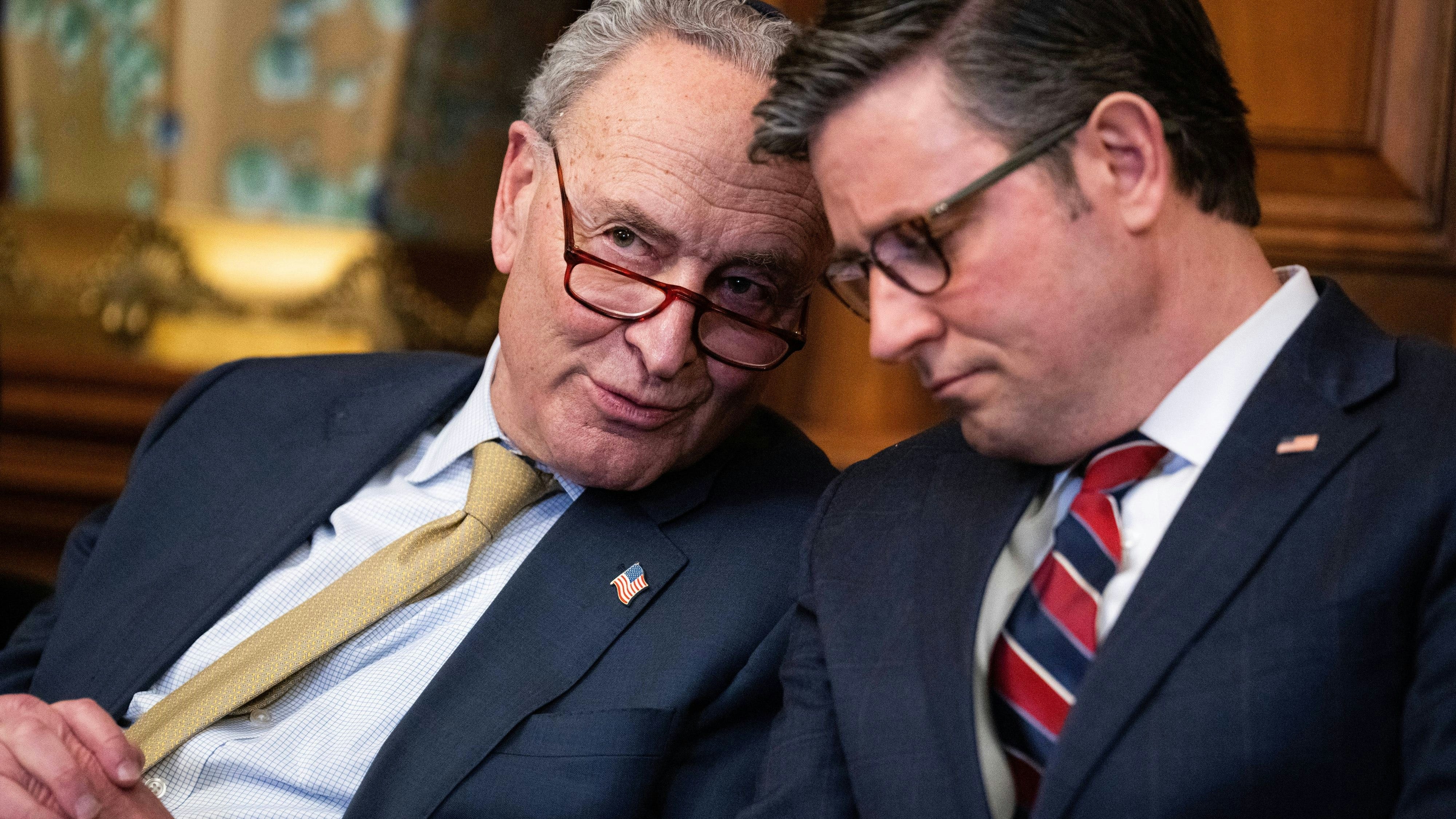
In response to a massive labor strike last Friday and two recent, caught-on-camera extrajudicial killings of activists in Minnesota, Democrats are scrambling to catch up to outrage among their base—and the population more broadly—over Trump’s brutal, violent, and terror-driven “immigration crackdowns.” Senate Democrats, feeling this pressure, are using their considerable leverage over the passage of a pending federal spending bill to push “reforms.” This Afternoon, Senate Minority Leader Chuck Schumer announced the agreed upon reforms, which are, per Sahil Kapur of NBC News: (1) Ending roving patrols; tighten the rules on warrants and require ICE to coordinate with local authorities, (2) Enforce accountability; a uniform code of conduct, (3) Requiring masks off, body cameras on, agents carry ID.
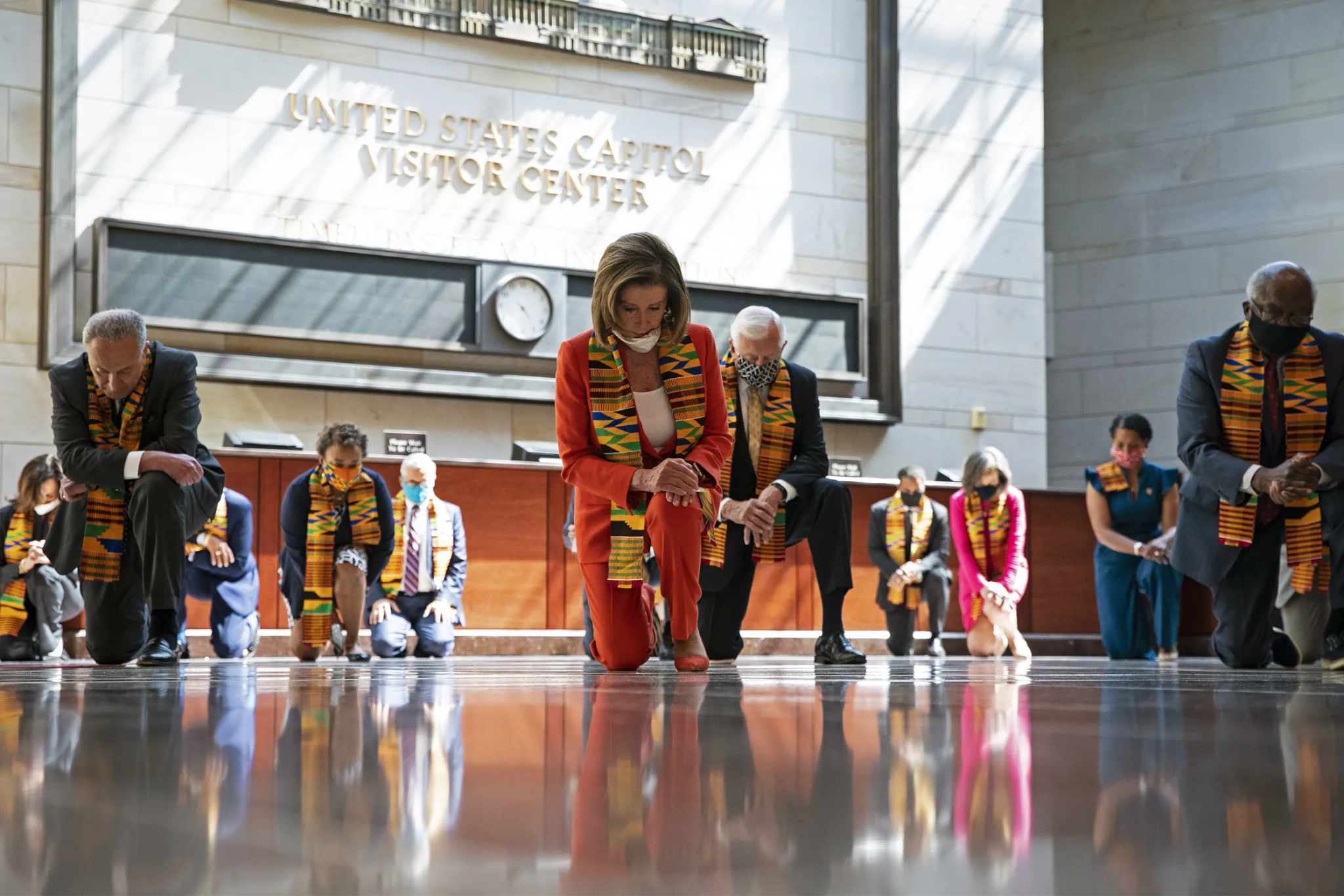
These proposed reforms range from trivial to actively harmful. Once again, public outrage and calls for meaningful change are being squandered on cosmetic tweaks and PR-driven non-interventions that will ultimately do little to meaningfully alter the incentives for Trump’s DHS mass deportation terror campaigns targeting major cities and states throughout the country. Put another way, Democrats are gearing up for a redux of their infamous 2020 kneeling kente cloth moment: shallow symbolism and feigned empathy combined with superficial reforms.
Before analyzing the problems with the reforms on offer by Senate Democrats, it’s important to understand, as I noted in The Real News a week ago, that ICE’s budget has more than tripled in the past year, from roughly $10 billion in 2024 to almost $30 billion in 2025. As Lindsay Koshgarian and Sarah Lazare detailed at In These Times, if ICE were a national army, it would be the 13th biggest in the world, larger than the militaries of Poland, Italy, Australia, Canada, Turkey, and Spain. Last year, the federal government received, via Trump’s “Big Beautiful Bill,” a staggering $170 billion in new funding for immigration enforcement through September 2029. On an annual basis, Koshgarian and Lazare note, “this adds about $42.5 billion per year for immigration enforcement.”
It’s from this place we must begin any discussions of “reform.” An entity that has tripled in size with the explicit mandate to round up, deport, and terrorize immigrant communities—while punishing anyone who gets in their way—cannot be meaningfully challenged without addressing the funding source for this mandate. With this in mind, let us breakdown the major issues with the proposed reforms:
End roving patrols; tighten the rules on warrants and require ICE to coordinate with local authorities. As many scholars have noted, Trump arresting people without warrants is already unconstitutional and illegal, but his DHS is doing it anyway. Passing laws to enforce existing law may dissuade the Trump regime in some contexts, but it’s unclear why Trump wouldn’t just ignore the new law since they duly ignored the previous one. It’s also not clear how the bill language will end up defining “roving patrols” or prevent their use, or—most important of all—what mechanism Congress would use to hold the Trump administration accountable to these standards. This type of administrative tweaking presumes a level of law-following and good faith the Trump administration has shown no evidence of abiding by.
Enforce accountability; a uniform code of conduct. Like many of the proposed reforms, the devil is very much in the details. It’s unclear how much power Congress or states would have to “enforce accountability” while Trump’s cartoonishly corrupt DOJ continues to investigate and threaten state lawmakers and leaders with prison time. Demands for state-led probes into the murders of Renee Good, Alex Pretti, and the dozens who have died in DHS custody are sensible in principle, but this dynamic is easily gameable, as we’ve seen with similar requirements by Congress the Trump DOJ release the Epstein files, which has resulted in a disclosure of a less than 1 percent of the files.
Require masks off, body cameras on, agents carry ID. As I also explained in The Real News last week, the abuses, kidnappings, and killings are not because those doing them are anonymous. Masking prevents real-time ID’ing and “doxing” from activists but does nothing to create real accountability. What emboldens abuses from DHS agents is open signaling from the White House that, in the event they abuse, kill, or wrongfully kidnap someone, they’ll have the backing of the federal government and receive zero punishment. These superficial measures do nothing to alter this calculus.
Meanwhile, reforms proposed by the progressive wing of House Democrats aren’t much better and suffer from much of the same myopia. They do include more substantive demands, such as banning arrest quotas and demanding “ICE and other agencies to withdraw from Minneapolis and stop terrorizing any additional American cities.” (ICE leaving Minnesota was a key demand of the January 23 economic shutdown.) But it’s unclear how Congress would define, much less enforce, these parameters. And most conspicuous of all, their demands make zero mention of reducing DHS’s obscene budget. For the supposed left flank of acceptable opinion in Congress, it’s staggering that there is no mention of DHS’s unprecedented funding levels in any of these demands.
What is essential to understand is that it’s from this obscene budget that ICE and CBP are able to run Donald Trump and Stephen Miller’s terror campaign at scale. This injection of $170 billion last year, on top of their baseline budget, is how the DHS can scale up hiring, how they can offer $50,000 sign up bonuses to new, ideologically-motivated recruits, and produce the mass saturation of armed agents to blanket multiple cities to create the requisite tension needed for their liberal city harassment and mass deportation campaigns.
The fact that progressives in Congress aren’t even advocating DHS’s budget return to its 2024 levels, or a reduction of ~66 percent, shows just how far to the right the Overton Window is. This should be a common sense, likely very popular, minimum ante to any discussion of meaningful reform—instead it’s relegated to the fringes of activist Twitter.
Minnesota Governor Tim Walz defends much of his inaction and acquiescence to Trump by claiming that to push back too much is to play into Trump’s hands: “They want a show,” Walz told protestors after the DHS killing of Renee Good, “we can’t give it to them.” Sen. Murphy, who is leading Democrats’ “reform” messaging, took it a step further, explicitly stating that Trump’s crackdowns were about creating a “pretext for Trump to take over elections in swing states.”


This is almost certainly true, but Murphy and Walz are ignoring the obvious implication of their premise: Why would Congressional Democrats vote to continue fully funding the primary tool for Trump to carry out this power grab? Why would Senate Democrats, after these token reforms, be fine maintaining ICE and CBP’s massive budget, permitting it to continue disciplining liberal cities, extorting them for their voter rolls, and potentially using ICE and CBP as an occupying or intimating force in the event Trump wants to corrupt—or outright steal—the 2026 midterm or 2028 elections? If liberals in Congress really believe that DHS agents are doubling as a brown shirt force for Trump (which they, in key ways, already are) then why are they supporting the continued tripling of the brown shirt force’s budget without so much as a public argument otherwise, much less a public fight? They either don’t actually believe this is a real threat, or they have some other secret mechanism of preventing the eventuality they are arguing is only months away.
Even if electeds are balking at “abolish” language, there’s a large grey area going totally unexplored. The fact that there’s no discussion of reducing DHS funding at all, or bringing it back to its 2024 levels by clawing back or redirecting the $170 billion in supplemental funds, is especially conspicuous when you consider that this is a position to the right of the public in general. A plurality of Americans now support abolishing ICE (46 percent for, vs. 41 percent against) and 76 percent of Democrats do. Meaningful budget cuts to the DHS are the compromise, centrist position. Yet Senate Democrats, and even supposed progressives in the House, don’t mention budget cuts in their messaging at all.
None of it makes any sense. At least it doesn’t outside the limited and professionally impotent corridor of Washington’s consultant class. For weeks, building up to this fight, a sprawling network of billionaire-backed Groups from Searchlight to David Shor’s Blue Rose to Third Way have been warning Democrats not to embrace “abolish ICE” or any budget cuts to the program. Per usual, this concern-troll posture is advanced under the banner of pragmatism and electoral necessity, not ideology. But the goal is very much about ideological discipling. The goal is to provide a veneer of empiricism to a predetermined conservative script and keep Congressional progressives focused on cosmetic or trivial reforms in lieu of expanding the debate into the realm of sizable funding cuts.
Outside observers cannot, of course, know for sure if there was a top-down party mandate to ignore the potential for defunding ICE and CBP. But given the uniformity of messaging, even among progressives in Congress, it is playing out this way in effect, if not intent. Those defending these reforms would say they are advancing what is possible, that these agenda items are simply what Congressional Republicans could potentially agree to. But Democrats have dispositive leverage at the moment. They can refuse to fund the DHS and take the debate to the public who, outraged by the visuals of kidnapping and murders, are on their side and, poll after poll shows, are very much amenable to meaningful, budget-based reform. The urgency to fund DHS is entirely on the Republicans’ part. By starting negotiations without challenging the premise that ICE should be the 13th largest army in the world, by refusing to go after the source of their power—their obscene budgets—congressional Democrats begin “negotiations” in an already right-wing, weakened framework. The fundamental problem with ICE and CBP abuses and killings is not a lack of “training,” or a lack of cameras capturing their lawlessness, or their lack of properly filled out legal paperwork or masks. It’s carte blanche immunity by the White House, fueled by their record-breaking budget. Democrats in Congress have little control over the former, but they have tremendous power over the latter. Their unwillingness to seize the moment to meaningfully and substantively rein in the power of Trump’s DHS by seeking to slash their $170 billion+ budget shows they are unable, or unwilling, to meet the moment.